Why Go Carry-On Only for 7 Days
These carry on packing tips will save you time, money, and stress on your next trip. Traveling carry-on only means no checked bag fees ($35-70 per flight on most airlines), no waiting at baggage claim, and zero risk of lost luggage. For a round trip, a family of four saves $280-$560 just on bag fees.
Beyond the savings, carry-on only travel makes you faster and more flexible. You walk straight off the plane and out the door. You can take trains, buses, and rideshares without wrestling oversized suitcases. And if your flight gets cancelled, rebooking is easier when you do not have checked bags to track down.
The biggest objection people have is “I cannot fit everything for 7 days.” You can. This guide breaks down exactly how to pack a carry-on for a full week, whether you are heading to a beach resort, a European city, or a business trip with leisure days mixed in.
Step 1: Choose the Right Carry-On Bag
Your bag choice determines how much you can fit. The maximum carry-on size for most U.S. airlines is 22 x 14 x 9 inches (including wheels and handles). International airlines sometimes allow slightly smaller dimensions, so check your airline before you fly.
For 7-day carry-on packing, prioritize these features:
- Capacity: 40-45 liters is the sweet spot for a week-long trip
- Softside vs. hardside: Softside bags with expansion zippers give you 10-15% more usable space
- Compartments: Look for interior compression straps, a clamshell opening, and a front pocket for quick-access items
- Weight: A lighter bag (under 7 lbs empty) leaves more weight budget for your belongings
- Wheels vs. backpack: Wheeled bags are easier in airports; backpacks are better for cobblestones, stairs, and public transit
Top carry-on bags for 7-day trips include the Away Carry-On, Osprey Farpoint 40, Travelpro Maxlite 5, and Peak Design Travel Backpack 45L. Each one fits within standard airline dimensions and offers enough organization for a full week.
Step 2: Build a Capsule Wardrobe (5-4-3-2-1 Rule)
The 5-4-3-2-1 rule is the foundation of carry on packing tips that actually work. It gives you enough variety for a week without overpacking.
Here is how it works:
- 5 tops: 3 casual (t-shirts or blouses), 1 nicer top for dinners, 1 active/athletic top
- 4 bottoms: 2 casual (jeans, shorts, or skirts), 1 dressy, 1 active (workout shorts or leggings)
- 3 layers: 1 light jacket, 1 sweater or cardigan, 1 scarf or accessory
- 2 pairs of shoes: 1 walking shoe (wear on plane), 1 flat sandal or dress shoe (pack in bag)
- 1 dress/formal outfit: For a nice dinner, show, or event
The Color Palette Strategy
Choose 3-4 colors that all coordinate with each other. A neutral base (black, navy, khaki, or gray) combined with 1-2 accent colors means every top works with every bottom. This gives you 20+ unique outfit combinations from just 12 clothing items.
Example palette for a warm-weather trip: Navy base, white, light blue, and coral accents. Example for a cooler trip: Black base, gray, cream, and burgundy.
Fabric Choices Matter
The right fabrics make carry-on only travel much easier. Look for:
- Merino wool: Naturally odor-resistant, temperature-regulating, wrinkle-resistant
- Nylon blends: Quick-drying, packable, durable
- Performance cotton blends: Look and feel like regular clothes but dry faster and resist wrinkles
Avoid 100% cotton, linen (wrinkles badly), and heavy denim for carry-on trips. A pair of technical travel pants weighs half as much as jeans and dries in 2 hours if you need to hand-wash them.
Step 3: Use Packing Cubes the Right Way
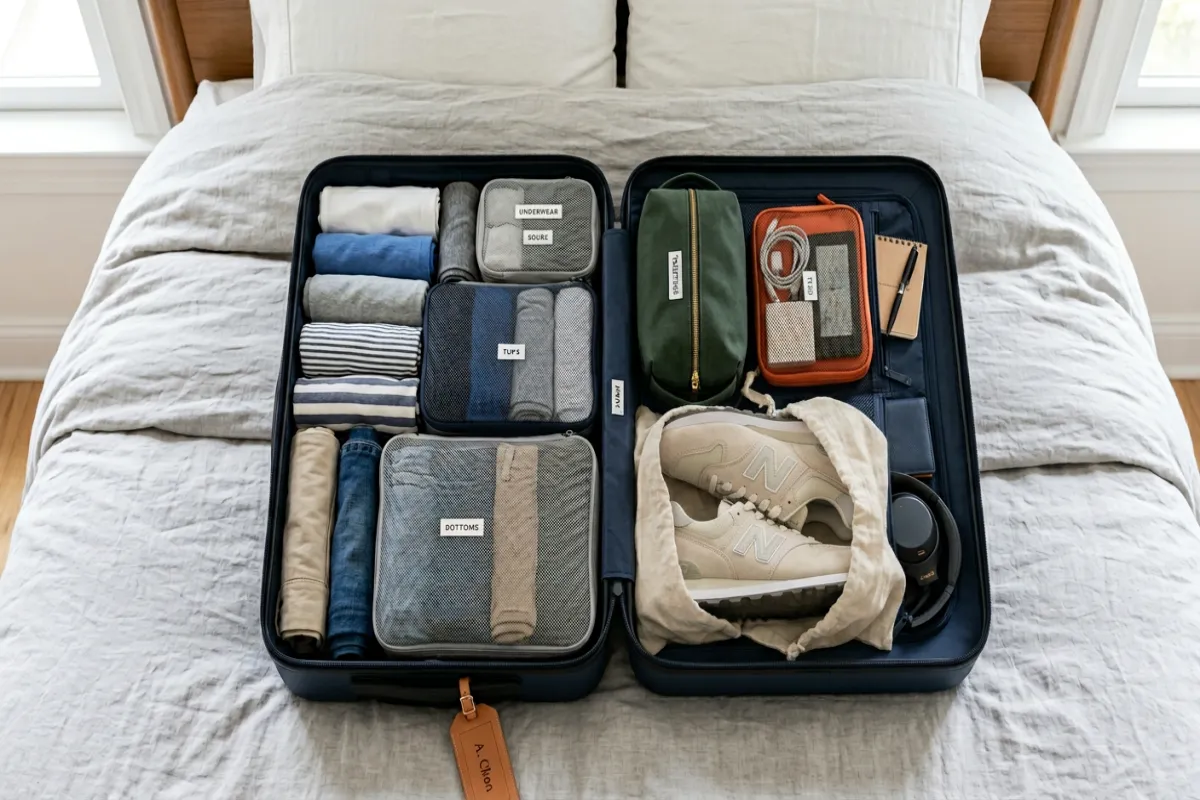
Packing cubes are the single most important carry on packing accessory. Compression cubes reduce clothing volume by 30-50% and keep your bag organized throughout the trip.
Here is the cube system that works for 7 days:
- Medium compression cube: All tops (rolled)
- Medium compression cube: All bottoms (folded or rolled)
- Small cube: Underwear and socks (7 pairs each)
- Small cube: Dirty laundry (starts empty, fills as the week goes on)
Rolling vs. Folding vs. Bundle Wrapping
Each technique works best for different types of clothing:
- Rolling: Best for t-shirts, casual pants, athletic wear, pajamas. Compresses well and prevents wrinkles in knit fabrics.
- Folding: Best for dress shirts, blazers, structured pants. Place tissue paper between folds to prevent creasing.
- Bundle wrapping: Best for minimizing wrinkles in delicate fabrics. Wrap items around a central core (like your toiletry bag) in alternating directions.
For most 7-day carry-on trips, rolling 80% of your clothes and folding the remaining 20% works perfectly.
Step 4: Toiletry Bag Under 3oz
The TSA 3-1-1 rule allows one quart-size clear bag with containers of 3.4oz (100ml) or less per passenger. Here is how to fit everything you need in that small bag.
Essential Liquids (Transfer to Travel Containers)
- Shampoo (3oz container – enough for 7+ days)
- Conditioner (3oz container)
- Face wash (2oz container)
- Moisturizer (2oz container)
- Sunscreen (3oz container)
- Contact lens solution (3oz container, if needed)
Solid Alternatives That Save Liquid Space
Swap liquids for solids to free up room in your quart bag:
- Shampoo bar instead of liquid shampoo (lasts 2-3 months)
- Solid deodorant (not counted in liquid limit if solid)
- Bar soap for face and body (travel-size, in a soap case)
- Toothpaste tablets instead of a tube (not a liquid)
- Solid perfume or cologne instead of spray bottles
By switching to solids where possible, you free up 3-4 liquid slots for products that only come in liquid form, like sunscreen and contact solution.
Non-Liquid Toiletries (Pack Outside the Quart Bag)
- Toothbrush (with cover)
- Dental floss
- Razor (disposable or safety razor with blade removed)
- Hairbrush or comb
- Hair ties and bobby pins
- Medications (in original containers)
Step 5: The Two-Shoe Strategy
Shoes are the biggest space challenge in carry-on packing. The two-shoe strategy solves it: wear one pair, pack one pair.
Wear on the plane: Your bulkiest, heaviest shoes. Walking sneakers, ankle boots, or hiking shoes. These would take up too much bag space, so they go on your feet.
Pack in the bag: Your lightest, flattest shoes. Sandals, ballet flats, slip-on loafers, or packable dress shoes. Place these in a shoe bag at the bottom of your carry-on or along the side wall.
This two-shoe approach covers 95% of activities on a 7-day trip. Walking shoes handle sightseeing, hiking, and casual dining. Flat sandals or dress shoes handle beaches, pools, nice restaurants, and around-the-hotel wear.
If you absolutely need a third pair (running shoes, heels for a special event), clip them to the outside of your bag with a carabiner or wear the bulkiest pair and pack the other two.
Step 6: Tech and Document Organization
A slim tech pouch keeps cords untangled and devices accessible. Here is what to include:
- Phone charger and cable
- Universal power adapter (for international travel)
- Portable battery pack (must be under 100Wh for carry-on, under 27,000mAh)
- Earbuds or headphones
- Laptop charger (if bringing a laptop)
- Kindle or e-reader (saves weight vs. books)
Keep these in a separate tech pouch or the front pocket of your carry-on for easy access at security. TSA requires laptops and large electronics to come out of the bag at screening (unless you have TSA PreCheck).
For documents, use Yopki’s trip planner to store digital copies of your passport, boarding passes, hotel confirmations, and travel insurance. Having everything accessible on your phone means less paper to carry and less risk of losing important documents.
Carry On Packing Tips for Different Climates
Warm Weather (Beach, Tropical, Summer)
Warm weather is the easiest for carry-on only packing. Lightweight clothes take up minimal space, and you need fewer layers.
- Swap one layer for a swimsuit and rash guard
- Pack a quick-dry towel (microfiber, packs to the size of a water bottle)
- One light rain jacket doubles as your only layer
- Sandals become your primary packed shoe
Cold Weather (Winter, Mountain, Northern Europe)
Cold weather requires more strategic packing. Layer thin, insulating pieces instead of bulky items.
- Wear your heaviest coat, boots, and sweater on the plane
- Pack a packable down jacket (compresses to the size of a water bottle)
- Merino wool base layers provide warmth without bulk
- Thermal leggings double as pajamas and base layers
- Pack a warm hat, gloves, and scarf in your personal item
Mixed or Unpredictable Weather
When the forecast is unclear, the layering approach works best:
- Bring one waterproof outer layer
- Pack a mid-layer (fleece or light sweater) that works for cool evenings
- Include one pair of pants and one pair of shorts to cover both warm and cool days
Check the 10-day forecast for your destination before packing. Yopki’s destination guides include climate information and suggested packing for popular travel spots.
Heading on a longer adventure? Our backpacking trip planning guide covers gear selection and packing strategies for extended travel. If you are packing for the slopes, see our ski trip planning guide for cold-weather packing advice.
What NOT to Pack in Your Carry-On
The “what not to bring” list is just as important as the packing list. These items waste valuable carry-on space:
- “Just in case” outfits. That formal dress or sport coat you might need? Leave it. You can buy or borrow if the occasion arises.
- Full-size toiletries. 3oz containers last 7-10 days. You do not need the full bottle.
- Multiple books. One e-reader holds thousands of books and weighs 6 ounces.
- A towel (unless it is microfiber). Hotels provide towels. A regular bath towel takes up a quarter of your bag.
- An umbrella. A waterproof jacket works better for travelers, and most hotels have loaners.
- Excessive accessories. One watch, one necklace, one pair of sunglasses. Done.
- Things you can buy at your destination. Cheap flip-flops, sunscreen, basic toiletries, snacks, and beach gear are all available at your destination for a few dollars.
Every item you leave behind creates space for something you actually use. Before putting something in your bag, ask: “Will I use this at least three times on this trip?” If the answer is no, leave it at home.
Complete 7-Day Carry-On Packing List
Clothing
- 5 tops (3 casual, 1 nice, 1 athletic)
- 4 bottoms (2 casual, 1 dressy, 1 active)
- 7 underwear
- 7 pairs of socks (3 regular, 2 athletic, 2 dress/no-show)
- 1 dress or formal outfit
- 1 swimsuit (if applicable)
- 1 pajama set (or use athletic wear)
- 3 layers (jacket, sweater, scarf)
Shoes
- Walking shoes (worn on plane)
- Flat sandals or dress shoes (packed)
Toiletries
- Quart bag with: shampoo, conditioner, face wash, moisturizer, sunscreen (all 3oz or less)
- Toothbrush, toothpaste tablets, dental floss
- Solid deodorant
- Razor
- Any medications
Tech
- Phone + charger
- Portable battery
- Earbuds/headphones
- Universal adapter (international)
- E-reader
Accessories
- Sunglasses
- Watch
- Reusable water bottle (empty through security, fill after)
- Small daypack or tote (folds flat in carry-on, use as personal item at destination)
Create your trip itinerary and packing list together with Yopki’s trip planner. Having your activities planned helps you pack exactly what you need and skip what you do not.
Once your bag is packed, make sure the rest of your trip is just as organized. Our complete trip planning guide covers everything from flights to daily itineraries.
Frequently Asked Questions About Carry On Packing Tips
Can you really pack for 7 days in a carry-on?
Yes. Using a capsule wardrobe approach and packing cubes, most travelers can fit 7 days of clothing, toiletries, and essentials in a standard carry-on bag (22 x 14 x 9 inches). The key is choosing versatile clothing that mixes and matches, using compression packing cubes, and wearing your bulkiest items on the plane. Thousands of frequent travelers go carry-on only for trips lasting 7-14 days.
What is the 5-4-3-2-1 packing rule?
The 5-4-3-2-1 packing rule is a capsule wardrobe system: pack 5 tops, 4 bottoms, 3 layers or accessories, 2 pairs of shoes, and 1 dress or formal outfit. By choosing pieces in a coordinating color palette, these items create 20+ unique outfit combinations for your trip. This system prevents overpacking while making sure you have options for different activities and weather.
Should I roll or fold clothes for carry-on packing?
Rolling is generally better for carry-on packing because it compresses clothes more tightly and reduces wrinkles in casual fabrics like t-shirts, jeans, and activewear. For dress shirts, blazers, and structured garments, folding with tissue paper prevents creases better. The best approach combines both: roll casual items and fold structured pieces. Packing cubes with compression zippers work well with either method.
What size carry-on bag is best for 7 days?
A carry-on bag measuring 22 x 14 x 9 inches (the maximum allowed by most U.S. airlines) with a capacity of 40-45 liters is ideal for a 7-day trip. Look for bags with interior compression straps, a dedicated laptop sleeve, and external pockets for quick-access items. Softside bags with expansion zippers give you 10-15% more space than hardside cases of the same dimensions.
What should you NOT pack in a carry-on?
Do not pack liquids over 3.4oz (100ml), sharp objects like scissors with blades over 4 inches, full-size aerosol cans, or anything you could buy cheaply at your destination (like beach towels, umbrellas, or basic toiletries). Also skip “just in case” items like extra shoes, formal outfits you probably will not wear, or multiple books. Each unnecessary item takes space from something you actually need.