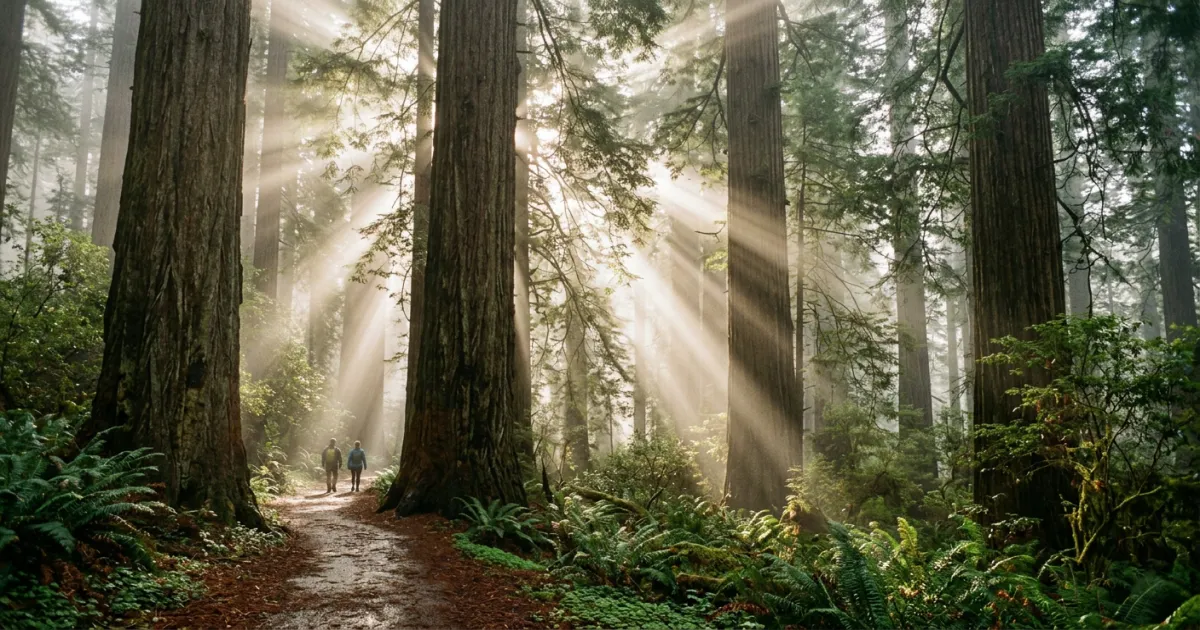
The Redwood forests of Northern California contain the tallest living things on earth. Trees that were alive during the Roman Empire reach over 370 feet into the sky, creating a cathedral-like canopy that filters sunlight into green-gold beams. Redwood National and State Parks, along with nearby Humboldt Redwoods State Park and the Avenue of the Giants, offer a chance to walk among these ancient giants. This guide covers everything you need to plan your trip. For a broader approach, see our step-by-step trip planning guide.
Key Planning Facts
- Location: Northern California coast, approximately 330 miles north of San Francisco
- Currency: US Dollar (USD)
- Language: English
- Park entrance fee: Free for Redwood National Park. State park day-use fees apply at some adjacent state parks ($8 per vehicle)
- Best months to visit: May to September (driest), with June and September offering fewer crowds
- Average daily budget: $100 to $200 per person
- Time zone: Pacific Time (PT)
- Nearest airports: Arcata-Eureka (ACV, 30 minutes south), Crescent City (CEC, inside the park area). San Francisco (SFO) is 5 to 6 hours south
- Park size: Redwood National and State Parks combined cover over 139,000 acres and protect 45 percent of all remaining old-growth coast redwood forest
Best Time to Visit the Redwoods
Summer (June to September)
The driest and warmest season, with temperatures of 55 to 75 degrees Fahrenheit along the coast. Coastal fog is common in June and July, which keeps temperatures cool and adds an atmospheric quality to the forest. August and September tend to be the clearest and warmest months. This is peak season, but the parks rarely feel crowded because of their size.
Spring (April to May)
Cooler temperatures (50 to 65 degrees Fahrenheit) with more rain. Wildflowers bloom, waterfalls run strong, and ferns are at their greenest. The rhododendron bloom in May is particularly beautiful among the redwoods. Fewer visitors than summer.
Fall (October to November)
Quieter than summer with pleasant temperatures and less fog. Rain begins to increase in late October. Some seasonal roads and trails may close. A good time for solitude among the big trees.
Winter (December to March)
Cool and wet (40 to 55 degrees Fahrenheit) with heavy rainfall. The forest is dramatic in the rain, with mist drifting through the canopy. Many campgrounds close for the season. Some roads may be impassable. Fewer services available in gateway towns.
How Long to Spend
A 2 to 3 day trip covers the main highlights: a scenic drive, 2 to 3 hikes, and the Avenue of the Giants. 4 to 5 days lets you explore deeper, including Fern Canyon, Tall Trees Grove (permit required), and the remote northern sections. The Redwoods are often combined with a larger Northern California road trip including Crater Lake (Oregon), Mendocino coast, or the Lost Coast.
Budget and Costs
The Redwood parks are relatively affordable because there is no national park entrance fee, hiking is free, and accommodation options include camping. The remote location means fewer dining options and slightly higher gas prices.
Daily Budget Ranges
- Budget: $80 to $120 per person per day. Camping ($35 per night), campfire cooking, packed lunches, free hiking
- Mid-range: $140 to $200 per person per day. Motels or B&Bs in Crescent City or Eureka ($100 to $180 per night), restaurant meals, guided tours
- Comfortable: $220 and up per person per day. Boutique inns or vacation rentals ($180 to $300 per night), dining out, scenic flights
Key Costs
- Park entrance: Free (Redwood National Park). State parks day-use: $8 per vehicle. Camping: $35 per night. Cabins (where available): $80 to $100 per night
- Gas: Remote area means higher gas prices. Fill up in Eureka or Crescent City before entering the park
- Meals: Limited dining options in the park area. Pack food for hikes. Restaurants in Crescent City and Eureka: $12 to $30 per meal
- Rental car: $50 to $80 per day. Essential for visiting the parks. No public transit within the park
Use our free travel budget template to plan your trip expenses.
Getting There and Getting Around
Driving
A car is essential. The parks stretch along 50 miles of the Northern California coast. The main route is US Highway 101. From San Francisco, the drive is 5 to 6 hours north. From Portland, Oregon, it is about 6 hours south. The drive itself is scenic, especially along the Avenue of the Giants.
Flying In
Arcata-Eureka Airport (ACV) is the closest commercial airport, with flights from San Francisco, Los Angeles, and a few other cities. Crescent City Airport (CEC) has limited service. Most visitors drive from San Francisco or fly into ACV and rent a car.
Within the Parks
Several scenic drives connect the main areas: Newton B. Drury Scenic Parkway (a 10-mile road through old-growth redwoods), Howland Hill Road (a narrow unpaved road through stunning groves near Crescent City), and the Avenue of the Giants (31-mile drive through Humboldt Redwoods State Park, slightly south of the national park). Many trailheads are along these roads.
Must-See Attractions and Experiences
Tall Trees Grove
Home to some of the tallest trees on earth, including Hyperion (379 feet, the tallest known living tree). The grove requires a free permit (limited daily, available from the visitor center or online). The hike is about 4 miles round trip with 800 feet of elevation change. The trail descends through old-growth forest to Redwood Creek.
Fern Canyon
A narrow canyon with 50-foot walls covered entirely in ferns. The short loop trail (1 mile) crosses a creek bed multiple times (expect wet feet). Featured in the film Jurassic Park 2. Access via Davison Road (rough gravel, may require high-clearance vehicle). A free permit is required for vehicle access from May to September.
Newton B. Drury Scenic Parkway
A 10-mile road through Prairie Creek Redwoods State Park. Easy to drive with multiple pull-outs for short walks among the giants. Big Tree Wayside (a short walk to a massive ancient redwood) is a highlight. Roosevelt elk are commonly seen grazing in the Elk Prairie meadow along this road.
Avenue of the Giants
A 31-mile scenic drive through Humboldt Redwoods State Park, home to the Rockefeller Forest (the world’s largest contiguous old-growth redwood forest). Roadside attractions include drive-through trees (kitsch but fun), the Founders Grove, and numerous pull-outs for short walks. The Avenue parallels Highway 101 and can be driven in about an hour without stops.
Howland Hill Road
A narrow, unpaved road (about 6 miles) through Jedediah Smith Redwoods State Park near Crescent City. Considered by many to be the most impressive old-growth drive in the entire park system. The road winds through towering redwoods so close you can almost touch them from the car. Stout Memorial Grove trailhead is along this road.
Lady Bird Johnson Grove
A 1.5-mile loop trail through old-growth redwoods, dedicated in 1968 by President and Lady Bird Johnson. Easy, accessible, and family-friendly. One of the best short walks in the park for experiencing the scale of the trees.
Enderts Beach
A short hike (1.2 miles round trip) down to a secluded beach with tidepools. Excellent for watching the sunset or spotting gray whales during migration season (December to April). Near Crescent City.
Food and Dining
Dining options within the parks are very limited. Plan to bring food for hikes and picnics.
- Crescent City: Small town with basic restaurants, grocery stores, and a few seafood spots. Fresh local fish and chips, chowder
- Eureka: The largest nearby city with a wider restaurant scene. The Old Town waterfront area has good dining options
- Arcata: A college town (Humboldt State University) with coffee shops, breweries, and farm-to-table restaurants
- Pack your own: Bring a cooler with food for the day, especially if you are camping or spending full days in the park. Grocery stores in Crescent City and Eureka can stock you up
Safety and Practical Tips
- Wildlife: Roosevelt elk are large and common, especially in Prairie Creek. Keep at least 50 feet away. Black bears are present but rarely seen. Mountain lions are rare. Store food properly at campsites
- Fallen trees: Large trees occasionally fall, especially during winter storms. Stay on designated trails
- Creek crossings: Some trails (especially Fern Canyon) require crossing creeks. Water shoes or waterproof hiking boots are helpful
- Road conditions: Some roads are unpaved and narrow (Howland Hill Road, Davison Road). Check conditions at visitor centers. Not all are suitable for large RVs or trailers
- Cell service: Very limited throughout the parks and surrounding area. Download offline maps and plan ahead
- Fog and cool temperatures: Coastal fog keeps summer temperatures much cooler than inland California. Pack layers and a rain jacket even in July. Temperatures inside the forest are 10 to 15 degrees cooler than in nearby towns
- Permits: Free permits required for Tall Trees Grove (limited daily) and vehicle access to Fern Canyon (May to September). Get permits from visitor centers or online
- Banana slugs: Bright yellow slugs are common on the forest floor. Do not step on them. They are an important part of the redwood ecosystem
Sample 4-Day Redwood Itinerary
Day 1: Avenue of the Giants and Humboldt Redwoods
Drive north from San Francisco (or fly into ACV and pick up rental car). Enter the Avenue of the Giants from the south. Stop at Founders Grove (short walk to the Dyerville Giant, a massive fallen redwood). Drive the full 31-mile avenue with stops at Rockefeller Forest and various pull-outs. Continue north to the Eureka/Arcata area for the night.
Day 2: Prairie Creek and Fern Canyon
Drive the Newton B. Drury Scenic Parkway. Stop at Big Tree Wayside and watch for elk at Elk Prairie. Hike to Fern Canyon (get vehicle permit if driving Davison Road, or hike the longer James Irvine Trail, 10 miles round trip). Afternoon: walk among old-growth trees on the Prairie Creek Trail. Continue north to Crescent City for the night.
Day 3: Jedediah Smith and Tall Trees
Morning: Drive Howland Hill Road through Jedediah Smith Redwoods (the most impressive old-growth drive). Hike Stout Memorial Grove or the Boy Scout Tree Trail (5.6 miles round trip). Afternoon: if you have a Tall Trees Grove permit, hike down to the grove (4 miles round trip, 3 to 4 hours). Evening: sunset at Enderts Beach.
Day 4: Coastal Exploration and Departure
Morning: Lady Bird Johnson Grove loop (easy, 1.5 miles). Drive south along Highway 101 with final stops as desired. Head to Arcata-Eureka Airport or continue south for a longer California road trip.
Planning Your Redwood Trip
Start building your custom itinerary with our free AI trip planner.
For more trip planning resources:
- Plan a Trip to California
- National Park Road Trip Planner
- Plan a Trip to Yosemite
- Free Road Trip Itinerary Template
Frequently Asked Questions
Is there an entrance fee for Redwood National Park?
No. Redwood National Park has no entrance fee. Some adjacent California State Parks charge a day-use fee of $8 per vehicle. Camping costs $35 per night at developed campgrounds.
What is the best time to visit the Redwoods?
June to September for the driest weather. August and September are the warmest and clearest. May and June bring wildflowers and rhododendron blooms. Winter is wet but atmospheric, with mist drifting through the canopy.
How tall are the redwood trees?
The tallest coast redwoods exceed 370 feet. Hyperion, the world’s tallest known living tree, stands at 379 feet in the Tall Trees Grove. Many trees in the park are over 300 feet tall and 2,000 years old.
Do I need a permit for Tall Trees Grove?
Yes. A free daily permit is required and limits the number of visitors. Get permits from the Thomas H. Kuchel Visitor Center or online. The permit includes the gate code for the access road.
How do I get to Fern Canyon?
Fern Canyon is accessed via Davison Road, an unpaved road that may require high-clearance vehicles. A free vehicle permit is required from May to September. Alternatively, hike the James Irvine Trail from the Prairie Creek Visitor Center (10 miles round trip) to avoid the road.
Can I drive through a redwood tree?
Yes. Several drive-through trees exist near the parks, including the Shrine Drive-Thru Tree and Chandelier Drive-Thru Tree near Leggett. These are privately operated attractions (about $10 per car) and not part of the national park, but they are fun roadside stops along the Avenue of the Giants.
Where should I stay near the Redwoods?
Crescent City (north end) and Eureka/Arcata (south end) have the most lodging options. Camping in the park is the closest and most immersive option. Book campsites in advance for summer through reservecalifornia.com.
Is the Avenue of the Giants part of the national park?
No. The Avenue of the Giants runs through Humboldt Redwoods State Park, which is separate from (but adjacent to) Redwood National Park. Most visitors include both in their trip. The Avenue is about 30 miles south of the national park’s main areas.
Do I need a 4WD vehicle?
Not for most of the park. Standard cars can handle Highway 101, Newton B. Drury Scenic Parkway, and most paved roads. High-clearance vehicles are recommended for Davison Road (Fern Canyon access) and Howland Hill Road (unpaved). Large RVs and trailers should avoid unpaved roads.
What should I pack?
Layers (the forest is cool even in summer), a waterproof jacket, sturdy hiking shoes or boots, water shoes for creek crossings, sunscreen, insect repellent, and a headlamp for camping. Bring a cooler with food since dining options are limited.